On the first Monday of the holidays I attended a Leading Change workshop run by Te Toi Tupu. This was a really interesting day and it was brilliant having the four of us who are working in the leadership team there. This allowed us to think critically about where we were at as a school and engage in critical reflection. I have copied in the notes that I made about the things that I viewed as important learning that we went through and they are a very interesting read. Lots of models that allow us to view the change that we are going through as a school in a new light.
Leadership and Assessment - Effective leadership of change
Showing posts with label RTC4-PD. Show all posts
Showing posts with label RTC4-PD. Show all posts
Sunday, 24 April 2016

Thursday, 14 April 2016
Leadership Research
During the first week of the holidays I am attending a Leading Change workshop run by Te Toi Tupu. As part of this we were required to read the following document and record three important points, two interesting things and one question.
See below for attachments.
Wednesday, 30 March 2016
The challenges around student centered learning - and overcoming them
Inquiry, curriculum integration, thematic units - these words were tossed around interchangeably when I first took up my new role at this school nearly nine weeks ago - however throughout this term we have begun to make changes around what our school curriculum looks like and how it is played out in action. This was due in part, to the leaving of both the previous principal and deputy principal within a short time period. As a result of this, lots of questioning is happening regarding the terminology that is used and what it actually represents. Through discussions and readings around inquiry and curriculum integration we have decided that as a school what we are currently doing is a thematic approach to learning, rather than true curriculum integration - and that true inquiry where it is led by the students is something quite rare within our classrooms and something that has not traditionally happened. This has aligned with the minimal focus that has been placed around student voice and student led learning that is future orientated due to other huge factors that have influenced the staff at the school. The students that I am working with came to me with quite a fixed mindset about what they could and could not achieve and it has taken eight weeks for them to begin to be at a stage where they are able to talk about their individual goals and their progressions towards these.
As year 7 and year 8 students, I think it is highly important that these students are introduced to, and confident working within, an inquiry style of learning both within the "core"/national standards subjects and all other subjects that make up the New Zealand Curriculum.
In order for me to provide my students with this opportunity I have done research over a wide variety of areas - regarding what inquiry is, best practice for student centered learning in areas such as maths, reading and writing and the benefits and challenges of true student centered learning. A lot of this has overlapped with reading that I did last year around the POGIL styled programme that I was teaching and so this has been most helpful to make comparisons with.
I know that as these students do not have a student centered learning background it is important for me to give them appropriate tools so that they are able to understand and talk about their learning in order to be able to have more guidance over the direction of it. An interesting reading that I stumbled across today The Benefits and Challenges of Student-Designed Learning talks about true inquiry learning (within a high school context) and letting students have complete control about the direction that they take with their learning and how they present their learning. It emphasises that from a student point of view, whilst it was exciting to have control over their learning at first it became difficult when they did not have any guidelines. It also discusses the importance of students having goals when directing their own learning and how this was helpful to them.
This has helped me to have confidence that I am on the right track with these students and developing them to be students who can work within an inquiry style of learning. At the moment there is both clear guidelines about what skills and knowledge they need to be developing, they are presented with a range of ways to do this which is helping to allow them freedom over the style of learning that works best for them and they are consistently setting and achieving mini goals whilst working towards their bigger goal which is allowing them to achieve success along the way.
As year 7 and year 8 students, I think it is highly important that these students are introduced to, and confident working within, an inquiry style of learning both within the "core"/national standards subjects and all other subjects that make up the New Zealand Curriculum.
In order for me to provide my students with this opportunity I have done research over a wide variety of areas - regarding what inquiry is, best practice for student centered learning in areas such as maths, reading and writing and the benefits and challenges of true student centered learning. A lot of this has overlapped with reading that I did last year around the POGIL styled programme that I was teaching and so this has been most helpful to make comparisons with.
I know that as these students do not have a student centered learning background it is important for me to give them appropriate tools so that they are able to understand and talk about their learning in order to be able to have more guidance over the direction of it. An interesting reading that I stumbled across today The Benefits and Challenges of Student-Designed Learning talks about true inquiry learning (within a high school context) and letting students have complete control about the direction that they take with their learning and how they present their learning. It emphasises that from a student point of view, whilst it was exciting to have control over their learning at first it became difficult when they did not have any guidelines. It also discusses the importance of students having goals when directing their own learning and how this was helpful to them.
This has helped me to have confidence that I am on the right track with these students and developing them to be students who can work within an inquiry style of learning. At the moment there is both clear guidelines about what skills and knowledge they need to be developing, they are presented with a range of ways to do this which is helping to allow them freedom over the style of learning that works best for them and they are consistently setting and achieving mini goals whilst working towards their bigger goal which is allowing them to achieve success along the way.
Monday, 21 September 2015
I've got something to say - Gail Loane
Recently as part of my professional readings I have been reading the book "I've got something to say" by Gail Loane. Below are things that I have read and that have captivated my interest and which I will both continue to do and also try to include into my practice.
We demonstrate how readers and writers think and behave - even when we are not consciously modelling it.
Every student has something to say -they might not always realise it though so it is our job to believe it and have our students believe it also. We need to include a variety of ways of doing this - it is important to provide time for reading, talking, listening, non verbal communication and writing daily - all of these aspects form literacy and communication not just one of them.
Lev Vygotsky (1978) describes language as a socially mediated process - where interactions with others play an important role in language development. When we transfer this to our classrooms it is clear that collaboration between students can help provide a way forward - indeed research demonstrates that when students respond to the work of others and seek feedback on their own work they show more definitive progress. Effective ways of applying this within senior classrooms include things such as partner conferencing, peer response, whole class sharing. These ways of working together are effective as they allow immediate feedback, the opportunity to make amends whilst writing, a wider range of opinions not just the teachers, a greater awareness of what works, a less threatening small group audience, chance to take risks and not just try and please the teacher - an opportunity for everyone's voice to be heard.
In order to teach writing effectively we need to ensure that we start with the whole and its meaning, draw out the teaching point for exploration and then return it to the whole. When we are deconstructing texts over a number of days it is important to acknowledge the context of the whole text - yes we may need to put a magnifying glass on a particular aspect of it but we then need to zoom back out for children to truly appreciate the effect of that aspect.
We demonstrate how readers and writers think and behave - even when we are not consciously modelling it.
Every student has something to say -they might not always realise it though so it is our job to believe it and have our students believe it also. We need to include a variety of ways of doing this - it is important to provide time for reading, talking, listening, non verbal communication and writing daily - all of these aspects form literacy and communication not just one of them.
Lev Vygotsky (1978) describes language as a socially mediated process - where interactions with others play an important role in language development. When we transfer this to our classrooms it is clear that collaboration between students can help provide a way forward - indeed research demonstrates that when students respond to the work of others and seek feedback on their own work they show more definitive progress. Effective ways of applying this within senior classrooms include things such as partner conferencing, peer response, whole class sharing. These ways of working together are effective as they allow immediate feedback, the opportunity to make amends whilst writing, a wider range of opinions not just the teachers, a greater awareness of what works, a less threatening small group audience, chance to take risks and not just try and please the teacher - an opportunity for everyone's voice to be heard.
In order to teach writing effectively we need to ensure that we start with the whole and its meaning, draw out the teaching point for exploration and then return it to the whole. When we are deconstructing texts over a number of days it is important to acknowledge the context of the whole text - yes we may need to put a magnifying glass on a particular aspect of it but we then need to zoom back out for children to truly appreciate the effect of that aspect.
Tuesday, 18 August 2015
Art and Creativity
As a school we have been lucky enough to have a local artist - Nicola Bennet - come to work with us during staff meetings and provide us with professional development around Art in the classroom. As a PRT I have found her wealth of knowledge and experience extremely helpful and in my own way am playing around with some of the ideas that she suggested.
Attached below are the two powerpoint slides that she has shared with us in order to inspire us. During each of these session we were able to experiment with and explore different aspects of her presentations.
Nicola Bennet - Art in the classroom
Anthropomorphic Images
At the moment in class we are doing an art portfolio unit where the children are being encouraged to explore a range of different types of art styles. The pieces that we are working on include sketching with charcoal, watercolour sketching, collage, paint, dye and pastel. The children are loving exploring their creativity through this unit and it is a wonderful opportunity to hidden talents emerging from a range of students.
One of the things that Nicola talked about was the way that Art is one of the things that people decide at a very young age that they either can, or cannot, do. I find it quite special that in my classroom a culture has developed where students are so encouraging of each other and of themselves - one wee young boy came up to me today telling me "Miss M - isn't my art great. I am so proud of it and I did my best - it doesn't look exactly like J's one - but I don't mind because it looks how I want it to look."
Another student came up to me whilst he was on independent writing today to discuss his work - he was thrilled with the creativity that he was involved in and shared with me how he was transferring his learning about gesture drawing in sketching into his writing. It was an exciting moment for both of us. My hope is that my students continue to feel this way about their creativity in art and across the curriculum for many years to come.
Attached below are the two powerpoint slides that she has shared with us in order to inspire us. During each of these session we were able to experiment with and explore different aspects of her presentations.
Nicola Bennet - Art in the classroom
Anthropomorphic Images
At the moment in class we are doing an art portfolio unit where the children are being encouraged to explore a range of different types of art styles. The pieces that we are working on include sketching with charcoal, watercolour sketching, collage, paint, dye and pastel. The children are loving exploring their creativity through this unit and it is a wonderful opportunity to hidden talents emerging from a range of students.
One of the things that Nicola talked about was the way that Art is one of the things that people decide at a very young age that they either can, or cannot, do. I find it quite special that in my classroom a culture has developed where students are so encouraging of each other and of themselves - one wee young boy came up to me today telling me "Miss M - isn't my art great. I am so proud of it and I did my best - it doesn't look exactly like J's one - but I don't mind because it looks how I want it to look."
Another student came up to me whilst he was on independent writing today to discuss his work - he was thrilled with the creativity that he was involved in and shared with me how he was transferring his learning about gesture drawing in sketching into his writing. It was an exciting moment for both of us. My hope is that my students continue to feel this way about their creativity in art and across the curriculum for many years to come.
John Hattie - Success Criteria
As a school we have been focussed on ensuring that our learning intentions and success criteria are developed alongside our students in a way that enables the students to both develop ownership and achieve success. We have been working through the book 'Clarity in the Classroom' by Michael Absolum. I have really enjoyed seeing the link between university studies and working within the classroom as this is the first book that we have used at university that has linked directly into what we have been doing in the school setting.
Last term we were videoed and after that we worked alongside a mentor from the senior management team to develop ways in which we could be more successful in helping learning intentions and success criteria become more commonplace and effective within our everyday teaching. For me, this is where all of my work with POGIL originated.
Last week in staff meeting we were shown this clip by John Hattie about learning intentions and success criteria and we discussed the importance of having these in very small breakable chunks for them to be most effective for students. Below are the notes that I took during this staff meeting and presentation. Some of this was just simply a reminder however aspects of it gave me something new to think about and consider.
- Learning Intentions are about what we are going to learn not what we are going to do. Best way to show success criteria is to model what a successful one would look like.
- If you have a clear understanding of what success looks like you are able to get rid of what matters and teach just that. If you don’t know what you want the kids to achieve in bite sized chunks, then it is impossible for the kids to know what they need to achieve.
- If we want to develop life long learning then we should not be the ones who are telling them they are successful – they need to be able to self regulate it against success criteria.
- Success criteria should not just be performance related – needs to be mastery focused also – and teachers need to show the students what mastery looks like.
- Need to have a deep understanding of where each child is to understand what success would look like for each kid – is it exactly the same for each child – and when it is not, how can we make it so that it is something that every child can achieve.
I have attached the link below so that you are able to watch it - I personally found the first half of it most effective.
Tuesday, 9 June 2015
NZCER: Styles of Learning
As part of questioning my planning of POGIL I have been doing some research into future orientated learning and the different learning styles that this teaching style caters for effectively. This is a reading that I found interesting as it simply restated what the different learning styles are and how they fit within a future orientated pedagogy. A timely reminder.
NZCER reading about learning
NZCER reading about learning
Tuesday, 2 June 2015
Teaching is a Journey
Coming out of university I had in my CV what I believed to be comments that spoke very highly of me as a student teacher. What I of course did not realise was the huge difference between being a student teacher and being a full time classroom teacher in charge of your own classroom. I had heard it all before from the teachers in my family - give yourself space to breathe, you can't do everything at once, everybody makes mistakes... and every time that I heard it from someone new I got frustrated. I didn't want to be a beginning teacher that felt like I was drowning and knew nothing - that may or may not however have been the exact impression that I gave off to the principal of my school in the first term. I would take everything on, and crumble inside - but remind management many, many times that I am brand new at this - it was in a way my excuse for not having everything perfect. What I didn't realise was that it was perfect at that stage to be a brilliantly imperfect teacher - and through not knowing things, making my own mistakes and learning from the mistakes of others was exactly what I was supposed to be doing - that was the perfect role for me at the time. I had left university as a teacher, and by mid year of my first year of teaching I had finally reaccepted my position as a learner. In line with this, I find the following saying very true - both for myself as a new teacher and for teachers who have been in their position for many years and may not necessarily want to learn new things.


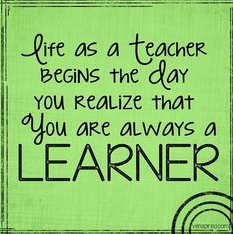
Over the following two terms, I relished my role as a learner - and soaked up as much as I could - whilst still learning the ins and outs of the school that I was working at. This year is where I believe that the change has been for me however. I have an outstanding tutor teacher who has complete faith in my abilities - both to teach successfully and to fail at teaching (and learn from it). Having a tutor teacher who has seen me succeed well, and seen me fail (not so well) has led to conversations that are very growth minded. He knows that I want to learn and grow and that I see myself as a learner - and so he has led from alongside me and provided direction by jumping on the learning journey with me. Working underneath this person has moved my love of teaching students to a passion for developing myself as a teacher continually. He has helped me set goals, visit other schools, observed me, helped me find professional readings that challenge me - and most importantly allowed me to play around with my own style of teaching. In my class I have been experimenting with POGIL (as referred to in previous posts). This has been one of the things that I have done as my Teaching as Inquiry this year - and I have fallen in love with it. Hence the next picture.

However, I am extremely grateful that I learnt the importance of viewing myself as a learner early on in my first year of teaching. The POGIL style of teaching was slightly chaotic at first and left my team leader making comments about the noise level in the room - and wondering if the students could concentrate at that noise level. However, as the weeks have gone by and I have adapted the philosophy behind POGIL to my classroom everything has settled down. The children love their new style of learning and so do I. They are inquisitive, they have urgency for their work - and they truly are learning because they want to - and for no reason except for that. They help to analyse their own data and determine what they will be learning and they love it. The same team leader came into my room last week and commented on how well the kids were working and the programme that they were doing. As a result of sticking with this, my whole team is now experimenting with POGIL styled mathematics tasks - adapted to the teachers individual journeys with POGIL.

This next picture stuck out to me because with POGIL this is true - my children work so well together that I know that the same depth and breadth of discussion could be happening regardless of whether or not I am in the classroom and working with their group. I have become far more of a facilitator and guide than someone who issues them with instructions etc.

I feel extremely honoured to work with such a great team at my school - and to have the support of other teachers. As well as my TT and my team leader I have had a small number of other teachers come and ask if they can observe how POGIL works also. My students are very keen to share their hard work and I am excited to have these other teachers in my classroom also. These teachers have no experience of POGIL and so it will be a learning curve for them just as much as it is from me and I am extremely interested to see the feedback that they have given me (My tutor teacher and team leader both have researched POGIL before coming to view it in my classroom).

My final thought for the night is the same thing that hit me half way through last year - the best teachers truly are the best learners - teaching is a journey where we help and support each other, through observations, through sharing readings and resources, through being able to talk things through, and sometimes by having a night off together that has absolutely nothing to do with teaching. I aim to be a brilliant teacher who can cater successfully to the individual needs of every student in my class - and to do that I need to be a pretty switched on learner. I am looking forward to continuing on with my teaching journey as a learner - and learning from everyone and everything around me.
PaCT - My Experiences
Today we had a teacher only day where we looked at the PaCT tool and made professional judgements for our students based on the mathematics and writing aspects of this tool. Whilst this tool may still be considered controversial amongst educators I personally found it to be quite a beneficial tool to use. The judgements do not take too long at all to make and I managed to get through my whole class for writing in about three hours - not too bad considering that this is the first time that we have used the tool for writing.
Tomorrow we are making our maths judgements - as I have more experience with making Math judgements against PaCT I have found that the aspects in the tool can be quite useful in helping me to plan a differentiated programme within my classroom as they expose maths in a different light to the numeracy project.
Attached is a booklet that I found extremely useful for helping to clarify what the different aspects were in reading, writing and maths when I was making my judgements.
PDF instruction booklet - PaCT
Tomorrow we are making our maths judgements - as I have more experience with making Math judgements against PaCT I have found that the aspects in the tool can be quite useful in helping me to plan a differentiated programme within my classroom as they expose maths in a different light to the numeracy project.
Attached is a booklet that I found extremely useful for helping to clarify what the different aspects were in reading, writing and maths when I was making my judgements.
PDF instruction booklet - PaCT
Monday, 25 May 2015
POGIL and my Teacher Inquiry
It is week six of term two, halfway through the term, and therefore probably an appropriate time to do a formal reflection of my teacher inquiry for this term.
My teacher inquiry question was:
How can I, as the teacher of a year six class, use strategies associated with POGIL to help my students develop independence and autonomy over their learning?
When this inquiry came about I discussed with my tutor teacher the importance of having a variety of sources of evidence to show whether or not this is working and highlight areas that need to change/develop and so I endeavour to do so below. I think that it is so important to have student voice as part of a measure of how successful I am in my teacher inquiry as realistically they are the ones whose learning it is affecting - and therefore they are the best people to be able to provide evidence. At times this is formal feedback in terms of videos and PMI charts and at times this is in the format of questions that my tutor teacher asks my students when he comes to observe me. As I will be referring to student answers to these questions throughout this reflection I have listed the questions below.
In order to do this reflection I am employing a variety of perspectives which I have attached as links either directly in here or in google drive:
- A PMI chart from the point of view of my students
- Video conversations with my students
- The introduction of questioning cards to develop discussion for students
- How blogging has provided a voice for my students
View the hyperlink above to see how blogging has given my students a voice - it has changed the class from our classroom where it is mostly teacher led to being there classroom where it is hugely student led. Be sure to read the comments - it is heart warming to see the way that they support each other, both in terms of providing positive feedback and in the way that they help each other through providing appropriate and timely feedforward. What is most amazing is the way that this feed forward and feedback has crossed from simply being an online tool and become part of how they communicate in the classroom - even my shy students are no longer hesitant to tell other students when they think they are doing well, or how they think they can improve.
- The purpose of success criteria, and how these have influenced what and how my students are learning
- Excerpts from professional discussions that I have had, both with my tutor teacher and with other teachers within what I consider to be my professional learning community
- Reflections on my planning for this style of teaching and how these have changed week to week
Success Criteria
I have hyperlinked Reading Success Criteria that students have created since the start of this term. This is entirely written in student voice with the children referring back to Sheena Cameron's reading comprehension strategy sheets when they get stuck.
I believe that success criteria tie in very closely with POGIL in terms of helping students have responsibility and ownership over their own learning. The following quote speaks volumes about this:
Professional Discussions
When running a programme such as POGIL in a classroom it is important to consider what deliberate acts of teaching I am still doing as a teacher. Recently we were video observed and these were some of the deliberate acts that were discussed:

Reflections on Planning
My planning has changed nearly every week that I have been running a POGIL based programme in my classroom. The children contribute to the changes, telling me what they like and what they do not like - and what is beneficial to their learning and what is superfluous. Based on my most recent discussions with my Tutor teacher I will be changing three things:
My teacher inquiry question was:
How can I, as the teacher of a year six class, use strategies associated with POGIL to help my students develop independence and autonomy over their learning?
When this inquiry came about I discussed with my tutor teacher the importance of having a variety of sources of evidence to show whether or not this is working and highlight areas that need to change/develop and so I endeavour to do so below. I think that it is so important to have student voice as part of a measure of how successful I am in my teacher inquiry as realistically they are the ones whose learning it is affecting - and therefore they are the best people to be able to provide evidence. At times this is formal feedback in terms of videos and PMI charts and at times this is in the format of questions that my tutor teacher asks my students when he comes to observe me. As I will be referring to student answers to these questions throughout this reflection I have listed the questions below.
- What were you learning today in …
- Why were you learning that?
- What tools have you used to ensure you are successful?
- How will you know if you are successful?
- When you are challenged in … what do you do?
- How do you extend your learning?
- What E score would you give yourself and why?
In order to do this reflection I am employing a variety of perspectives which I have attached as links either directly in here or in google drive:
- A PMI chart from the point of view of my students
- Video conversations with my students
- The introduction of questioning cards to develop discussion for students
- How blogging has provided a voice for my students
View the hyperlink above to see how blogging has given my students a voice - it has changed the class from our classroom where it is mostly teacher led to being there classroom where it is hugely student led. Be sure to read the comments - it is heart warming to see the way that they support each other, both in terms of providing positive feedback and in the way that they help each other through providing appropriate and timely feedforward. What is most amazing is the way that this feed forward and feedback has crossed from simply being an online tool and become part of how they communicate in the classroom - even my shy students are no longer hesitant to tell other students when they think they are doing well, or how they think they can improve.
- The purpose of success criteria, and how these have influenced what and how my students are learning
- Excerpts from professional discussions that I have had, both with my tutor teacher and with other teachers within what I consider to be my professional learning community
- Reflections on my planning for this style of teaching and how these have changed week to week
Success Criteria
I have hyperlinked Reading Success Criteria that students have created since the start of this term. This is entirely written in student voice with the children referring back to Sheena Cameron's reading comprehension strategy sheets when they get stuck.
I believe that success criteria tie in very closely with POGIL in terms of helping students have responsibility and ownership over their own learning. The following quote speaks volumes about this:
" If learners are to take more responsibility for their own learning, then they need to know what they are going to learn, how they will recognise when they have succeeded and what they should learn it in the first place." (An Intro to AfL, Learning Unlimited, 2004).Between the learning intention covering the what and the why - and the self created, and peer reviewed, success criteria covering the how students are able to gain insight and control over their own learning - and this is demonstrated both in the PMI chart and the video that are hyperlinked above.
Professional Discussions
When running a programme such as POGIL in a classroom it is important to consider what deliberate acts of teaching I am still doing as a teacher. Recently we were video observed and these were some of the deliberate acts that were discussed:

My focus now is to move away from questioning as the students have the tools and the experience to do that and move towards prompting as my key form of feedback - obviously all strategies are going to need to be applied at different times.
Reflections on Planning
My planning has changed nearly every week that I have been running a POGIL based programme in my classroom. The children contribute to the changes, telling me what they like and what they do not like - and what is beneficial to their learning and what is superfluous. Based on my most recent discussions with my Tutor teacher I will be changing three things:
- Writing the learning intention for the week in the format of 'We are learning to... because...' so that students can see immediately what the relevance is and therefore be able to discuss this.
- Recording the way that I frame the activity and the learning so that students are able to clearly identify the difference between the two. This is where students have been getting stuck when asked the questions identified earlier - whilst my top students are able to highlight the difference without any problem some of my lower students struggle to and this is the group that I need to be specifically targeting. An example of this is recorded below:

- Giving students full control about what they learn and when based on appropriate data. An example of this: We are just beginning an algebra based unit. The students have all recently completed a pretest - the level of which was determined by me from looking at data against knowledge and strategies. The pretest has each page set out in the following format:
 Each skill that the children need is recorded at the bottom of the page and once we have marked each page together they select 'not yet', 'kind of' or 'got it'. The students work with other children in their skill level and determine their learning for the next five weeks. They have decided to split their data up into two categories for them to focus on when they are with me: a revise category, based on the problems that they kind of understand, and a learn category based on the problems that they do not yet understand. An example of this is recorded below
 This style of planning where students have such a high level of input develops feelings of responsibility, pride in what they have already achieved and a sense of direction and ownership in what they will achieve next. Obviously I still have to make judgements based on their self directed pathways - but planning this way and letting the children access and read their data is very much personalising both the planning and their learning journey.


Overall - when I reflect on the question of "How can I, as the teacher of a year six class, use strategies associated with POGIL to help my students develop independence and autonomy over their learning?" the following things come to mind:
What I have already done and need to continue to do:
- Continue to use POGIL sheets to structure students learning
- Continue to use question sheets
- Adapt my planning to meet the needs of my students
- Use the weebly to make learning interactive and engaging for students
- Allow students to direct their own learning
What I need to do next:
- Provide students the opportunities to have a real contribution to what they are learning
- Use their weebly as a place where all students have the opportunity to view similar problems (for want of a better word) to the ones that they will be working with when they are with the teacher.
- Move away from questioning and towards prompting
- Change how I structure the learning intentions for students - especially in writing and reading.
Sunday, 3 May 2015
Personalisation, differentiation or individualisation?
Over the weekend I have been doing some reading about the difference between personalising learning, differentiating learning and providing individualised learning. All three of these words are thrown around in education and are often referred to interchangeably. This chart and this report have provided me with a lot to think about in relation to what style of teaching I am currently implementing with the POGIL style learning, and where I want to move this too. Very interesting and worth a read.
Personalisation vs differentiation vs individualisation chart
Personalisation vs differentiation vs indvidualisation Reading
Personalisation vs differentiation vs individualisation chart
Personalisation vs differentiation vs indvidualisation Reading
Monday, 27 April 2015
Future Oriented Learning - POGIL - What do they mean for me?
I decided that the long weekend was the perfect time to do a reading (as well as go to the beach and see friends) and so I did some research to find readings that weren't POGIL related but focussed on similar themes! I came across a report by the NZCER titled 'Supporting future-oriented
learning and teaching – A New Zealand perspective' and thought that that sounded interesting. The following notes are insights that I gained from this reading that also connected with principles behind the POGIL style of teaching and the writing in italics is how this can, or already does, apply to my classroom.
Knowledge
- · Need to adopt a much more complex view of knowledge that incorporates knowing, doing and being
- · Knowledge – currently our views are underpinned by two different epistemologies of what counts as knowledge. These are: knowledge as content, concepts and skills from the selected disciplines – and – knowledge as creating and using new knowledge to solve problems and find solutions to challenges as they arise on a “just-in-time” basis
- · A new view of knowledge and the implications for schooling – We can no longer predict exactly what content specific knowledge students will need as they move through life in the
- 21st century. But we do know that they need: opportunities to build their sense of self, challenges that will develop them into becoming self-reliant, critical and creative thinkers, the ability to use their initiative, the ability to become team players and the drive to engage in ongoing learning throughout their lives
- · In order for students to remain engaged in the long term they must be able to actively interact with knowledge rather than just reproduce it – they must be provided with the opportunities and skills to understand, critique, manipulate, create and transform it.
- · 21st century learning literature argues that today’s students need to engage in knowledge-generating activities in authentic contexts – we need to move away from formal contemporary learning to the messiness of real world situations in which the answers and outcomes are not known, or predetermined by the teacher, but rather where teacher and student work alongside each other on a learning journey.
In my classroom - knowledge is shifting from knowing to incorporating doing - I have not yet discovered how to get to the being stage with my students yet. I have found that with the students using POGIL styled activities they are working with activities that are much more engaging, hands on, and higher level thinking. With the two different epistemologies I think it is important that both play a place within my classroom - and this is evident through the way that I teach - students both understand knowledge in regards to content and skills and create their own knowledge in order to problem solve in a range of situations. Hugely within my reading and maths sessions students are provided with opportunities to understand, critique, manipulate, create and transform knowledge thanks to the POGIL style of learning. Within reading at the moment students are completing challenges that at first made me uncomfortable largely due to the fact that they are higher order Blooms creative styled challenges - these children are going to be creating work where their answers cannot be predetermined because what they are doing is authentic knowledge building.
Learning
- · Requires that all of those involved in education are involved in continuous learning
- · Focus in future oriented learning needs to be on equipping people to do things with knowledge
- · What we know about learning:
o
Learning
involves thinking
o
Experiences
are critical to learning
o
Learners
need to be encouraged not to search solely for the right answer but also for
the right approach to solving a problem
o
To learn,
people need to be actively engaged. They
need to be doing something, thinking something and or saying something that
requires them to actively process, interpret, and adapt an experience to a new
context or use.
o
Learners
have to want to learn the material – both in the short term and in the longer
term they need to see a purpose to learning it.
o
Learning
has to be personalized – they need to feel that they know what they are doing,
and that they can control the pace of their learning
o
Learning
often needs some kind of structure
o
Learning
involves interaction – testing out and trying ideas with others.
- · In order for captivating learning to occur there is the idea that the learner ought to be transformed in some way through their learning and the idea that the world can be transformed by the learner – that what they are learning can impact their world almost immediately.
I like the idea that all of those involved in education are involved in continuous learning. I know that through my own professional and personal learning I develop as teacher every day and that if I was the same person that I was at the start of the year even, and if I taught in the exact same way then the learning of my students would not be enhanced. Future oriented learning does indeed need to be focussed on equipping people to do things with knowledge. With knowledge being so easily accessibly through the internet these days it does not become so much the content of the knowledge that will drive the future of our students so much as what they do with this knowledge - how they manipulate it and use it to enhance the lives of people around them. Within my current reading programme at the moment students are experiencing a variety of experiences that involve them relating what they are reading about directly to the world that they live in - with this, the activities that they are doing do not have a single right answer, but rather a variety of correct answers and what matters is the way that they get there - I would like to further incorporate this idea within my maths programme also.
Key Competencies
- · Learning that is future oriented is closely linked and connected with the Key Competencies. This article states that ‘deep learning’ involves self managing, being creative and critical thinkers and learning with others.
- · The Key Competencies are so important to how we teach – when we have developed the understanding and application of these effectively in students is when students are able to transfer the knowledge and skills that they are learning about to whatever context they find themselves in.
Whilst my WALTs may not match directly with the key competencies the students are required to fill out an evaluation at the end of each task that is directly related to their key competencies - there is a focus on each of the key competencies but these are written in student speak. When the students arrive to teacher time with me we discuss what they need to work on next time and through this discussion we focus on what is important for allowing them to learn and grow effectively. It would possibly be effective for me to discuss these evaluations in the terminology of the Key Competencies and this is something I may explore doing.
Diversity/Authentic Learning
- · Diversity is key for learning that supports children in the world that they will be a part of tomorrow – this calls for greater engagement of learners in co-shaping their education to address their needs, strengths, interests and aspirations
- · Diversity encapsulates the current focus on developing strategies to ensure learners from all backgrounds can achieve success in ways that are meaningful to them.
- · The goal with education today is not simply to find better ways to raise every person’s achievement to an identical view or standard – which is a tricky concept with national standards saying the opposite – but rather to support each individual to reach their full potential.
- · Deep expressions of the practice of personalizing learning occur as listed below:
o
Learners
have genuine input into shaping what happens in their learning, not only how
they learn but also what sorts of learning activities occur within their class.
o
Learners
(not just their teachers) believe that students have input into how things
happen in their classroom or school.
o
Learners
can link their schooling to other aspects of their lives, or see connections
with their goals or aspirations for their lives beyond school
- · In regards to authentic learning opportunities – it is not enough for the learning to seem as though it is relevant, engaging and connected to student interests. Rather, we as educators, need to provide opportunities and strategies that support students themselves to feel engaged with, connected to and invested in the work that they are doing.
I believe that developing authentic learning within a classroom is an ongoing thing that changes continually with what you are teaching and how you are teaching it. Developing an attitude and practice that allows students to engage quickly with authentic learning is a different thing. This is something that I am working on in both my reading and maths programmes at the moment. In writing we have set genres that we have to cover at certain times, however students get input into what they write about. In reading - on a Friday afternoon, students are provided with journals that have articles in them that may capture their interest about the current topic of study. Each group usually has about three or four choices each week. From here, the students are able to decide what they want to learn about within this topic and choose a verb from the three higher levels of BLOOMs taxonomy that relate to what they are wanting to learn. Within Maths the students sit a eAsttle test that provides them with next steps within their current subtopic and from their they direct where they want their learning to go based on both needs and interests.
Roles of teacher and student
- · The idea of personalizing learning call for reversing the logic of education systems so that the system is built around the learner rather than the learner being required to fit in with the system
- · We need to rethink the role of the teacher and students – as it is no longer the teacher’s job simply to transmit knowledge and the student no longer has the main purpose of absorbing and storing up knowledge to use in the future. We need to consider about how we are structuring roles and relationships in way that draw on the knowledge and strengths of both teacher and student in order to best support learning.
- · Classrooms need to not be labeled as student centered or teacher driven whilst these terms are still being loosely thrown around but rather should involve teachers and students working together in a knowledge building environment,
- · Students are most engaged with, and get the most out of, learning that allows them a degree of choice, flexibility, motivation and self direction in their learning.
Tuesday, 24 February 2015
Four Minute Walk Throughs
One of the things that I am focussing on with my TT at the moment is how to gain insight from observing others that can help both them and myself to grow as teachers - as opposed to just taking away a 'cool' game or something similar. In order to give me some background understanding of how this could occur before our meeting, he gave me a book to have a read of: Four minute walk throughs - seeing through new eyes.

There were some things in this book that I truly agreed with and some that I questioned - I will detail these briefly below.
The first idea is that Educational change is technically simple and socially complex - all I have to say for this one is that I am glad I am not the only one who finds it so.
The second is the benefit of using other teacher's practices to critique your own practice. As a BT, I am lucky enough to spend a day a fortnight outside of my own classroom doing whatever it is that I need to do for school. One of the things that I am looking forward to is observing other teachers - both those who I perceive as expert and those who I perceive more on being on the same level as myself. I think there are huge benefits from both when you consider, as this book suggests, that you can critically examine aspects of teaching practice in other teachers without feeling threatened or becoming defensive and that this critical analysis can then be applied to your own practice - both through reflection and physically changing the atmosphere of the classroom and what is occurring within each lesson.
A statement within the book is that "truth is the one non negotiable element in building a powerful learning culture" - both seeing the truth and talking about the truth. I think as a BT being observed often this is a really powerful lesson that I need to remember. If I am to learn all I possibly can from those who have more experience and who have learnt lessons then I need to be open to the truth - recognising what others are saying as something that is helping me and not making excuses for reasons not to talk about the truth. In saying this, I also need to be confident to speak what I believe to be the truth about certain matters also.
When others have walked through my classroom previously, especially with walkthroughs done by a colleague last year I have felt threatened - as though I was being judged and would be negatively critiqued at a later date. Through seeing how the 4MWT aligns with the key competencies I am beginning to understand that that is not the purpose of it at all. These are done to: help one manage themselves - ensure that they are offering the best to their students that they possibly can, help with the sharing of ideas, recognising different perspectives and interact effectively with others, create opportunities to connect with others and to allow opportunities to be creative, critical and reflective of our own practice with the guidance and support of others. In line with this is the statement in the book "A classroom walkthrough is not about judging a teacher; it is about observing and supporting reflective dialogue on student learning."
The process of conducting a four minute walk through and the reasons behind it are much clearer after having read this book - I am looking forward to learning how to follow the below structure effectively so that I can get the most out of observations, both for myself and for the teachers who I am observing.
Reading through this book also provided some insight into how I am running my own programmes and what I can do to make them look how I want them to look. One of my goals for this first term is to develop student ownership in their learning and to move myself more to a role of facilitator. I had discussed with my TT how I thought this could happen and what I could do - and had left it as a pondering. When reading this book Blooms taxonomy was brought to my attention and I realised that the majority of the tasks that I am setting my students are at the knowledge and comprehension phases. I am effectively asking them to recall and understand information without applying it at a deeper/further level. This is not a great realisation to have obviously but one that is good to have had at the start rather than at the end of the year. When students are completing knowledge and comprehension tasks they are not creating, applying, critically analysing or synthesising new information - and without doing this it is difficult for them to feel that they have control over what they are doing and how they are learning. An interesting point for discussion with my tutor teacher would be how I can develop this within the structures and team plans that are already at place within the school.
Monday, 17 June 2013
Subscribe to:
Posts (Atom)