Showing posts with label Inspiration. Show all posts

Tuesday, 28 July 2015

Ken Robinson - Inspiration and Food for Thought

I have recently visited a school who have taken a lot of inspiration from the TED Talk by Ken Robinson titled: How to escape education's death valley.

Watching it gave me a lot to think about - both in terms of my practice, the practices occurring within my current school and the practices that are occurring nationwide.  Below are notes that I took from this speech and that will influence the way that I continue to teach.

Human beings are naturally different and diverse:
The problem with education arises when education is being based on conformity and focuses on acknowledging children’s achievements against a narrow curriculum -  STEM. For the curriculum to provide opportunities for children to flourish it needs equal weighting also applied to the arts, humanities and physical education.  Research has proven that children prosper when they are provided with a wide curriculum that recognises all their talents.

Curiosity
If a parent or educator can light the spark of curiosity children will learn naturally.  Curiosity is the engine of achievement.  Teaching aligns with this as teaching is a creative profession – within each day an effective teacher may ake on the roles of mentor, stimulator, thought provoker, and someone who engages others.  When this is true it is important that educators continue their own learning and developing their own curiosity. 
Put at its most simple the role of a teacher is to facilitate learning – not to facilitate tests.  There is a need to move away from standardized testing – it is still important and needs a place however it should not be dominant but rather diagnostic.

Human life is inherently creative
Each day every one of us is creating our lives and with each decision we make we continue to create them.   Our role as teachers is to awaken and develop powers of creativity within our students.  At its most effective, learning is developed though curiosity, and the individuality creativity that stands alongside curiosity. 
Education is about people and seeds of possibility lie beneath the surface of each child waiting for the conditions to be right – and if the conditions are right individual success is inevitable.  Within education these conditions are possibility, positive relationships, high expectations, a range of opportunities, and the discretion to be creative and innovative.  Leadership and teaching in education should not be command and control but rather climate control – and creating a climate of possibility – when this occurs people will rise to and exceed expectations.

Benjamin Franklin once famously said that “All mankind is divided into three classes: those who are immovable, those who are movable and those who move.”


My mission for myself: Be someone who makes things happen.

Friday, 17 July 2015

Feeling prepared and ready to go!

I love the holidays for two reasons. One - they are a time of rest and relaxation after a crazy term and two - you end them feeling like you are on top of everything and ready to take on the world.  And what a feeling it is!!

Every teacher - and every student - could tell you about the importance of teachers being energetic and lively and how this impacts student teaching, however I can certainly say that in the last few days of an 11 week term those words are not adjectives that I would have chosen to describe myself.

Having spent the past two days in school I feel refreshed, renewed and filled with enthusiasm about the coming term.  I have changed around my planning and have been inspired to create a mini inquiry into some of my lowest students for writing - these are students who are below and not quite well below but will still need a lot of directed and individual focus to get them to where they need to be by the end of the year.  My mini inquiry is based around the question: "If I work daily with my struggling writers, instead of seeing them twice a week, will this provide them with the structured guidance that they need to have moved up a sublevel by the end of term - and to also have transferred their learning across to their independent books?"  Usually I mark writing books with the students when conferencing and then make notes about what to discuss with them from their follow up sessions.  With this group I will be conferencing with the three of them daily in a group session but then also marking their follow up with them in the afternoon and having them hand in their independent writing books each night for me to be able to see also.

I have attached as google docs some of the planning that we have done for this term  - and also my weekly timetable for the first week.  I have not yet planned my Maths as the students will be doing a pretest before the lesson - also where it says POGIL this means that the students have their own sheets of activities that they work their way through - based on the focus within the teaching session and their choice of what they need to learn at that time - decided through conferences and goals.

Below are attachments that highlight what our focus will be for the first three weeks of school.

Unit Plans
As a school we don't do unit plans for reading or Maths - these are done individually as they are very particular to each class.

Class Plans

Examples of resources that go with plans

Reading
Speeches and follow up activities based on blooms for the follow people:
Bill Gates - Speech and Comprehension work
Malala Yousafzai - Speech and Comprehension work
MLK - Speech and Comprehension work
Kid President - Speech and Comprehension work
Kid President - Static text work

Writing
Explanation plan and written piece exemplars

Maths
Y6 Level Pretest

Tuesday, 2 June 2015

Teaching is a Journey

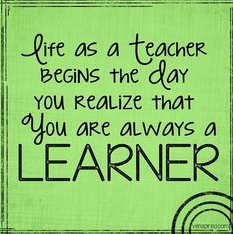
Coming out of university I had in my CV what I believed to be comments that spoke very highly of me as a student teacher.  What I of course did not realise was the huge difference between being a student teacher and being a full time classroom teacher in charge of your own classroom.  I had heard it all before from the teachers in my family - give yourself space to breathe, you can't do everything at once, everybody makes mistakes... and every time that I heard it from someone new I got frustrated.  I didn't want to be a beginning teacher that felt like I was drowning and knew nothing - that may or may not however have been the exact impression that I gave off to the principal of my school in the first term.  I would take everything on, and crumble inside - but remind management many, many times that I am brand new at this - it was in a way my excuse for not having everything perfect.  What I didn't realise was that it was perfect at that stage to be a brilliantly imperfect teacher - and through not knowing things, making my own mistakes and learning from the mistakes of others was exactly what I was supposed to be doing - that was the perfect role for me at the time.  I had left university as a teacher, and by mid year of my first year of teaching I had finally reaccepted my position as a learner.  In line with this, I find the following saying very true - both for myself as a new teacher and for teachers who have been in their position for many years and may not necessarily want to learn new things.


Over the following two terms, I relished my role as a learner - and soaked up as much as I could - whilst still learning the ins and outs of the school that I was working at.  This year is where I believe that the change has been for me however.  I have an outstanding tutor teacher who has complete faith in my abilities - both to teach successfully and to fail at teaching (and learn from it).  Having a tutor teacher who has seen me succeed well, and seen me fail (not so well) has led to conversations that are very growth minded.  He knows that I want to learn and grow and that I see myself as a learner - and so he has led from alongside me and provided direction by jumping on the learning journey with me. Working underneath this person has moved my love of teaching students to a passion for developing myself as a teacher continually.  He has helped me set goals, visit other schools, observed me, helped me find professional readings that challenge me - and most importantly allowed me to play around with my own style of teaching.  In my class I have been experimenting with POGIL (as referred to in previous posts). This has been one of the things that I have done as my Teaching as Inquiry this year - and I have fallen in love with it.  Hence the next picture.


However, I am extremely grateful that I learnt the importance of viewing myself as a learner early on in my first year of teaching.  The POGIL style of teaching was slightly chaotic at first and left my team leader making comments about the noise level in the room - and wondering if the students could concentrate at that noise level.  However, as the weeks have gone by and I have adapted the philosophy behind POGIL to my classroom everything has settled down.  The children love their new style of learning and so do I.  They are inquisitive, they have urgency for their work - and they truly are learning because they want to - and for no reason except for that.  They help to analyse their own data and determine what they will be learning and they love it.  The same team leader came into my room last week and commented on how well the kids were working and the programme that they were doing.  As a result of sticking with this, my whole team is now experimenting with POGIL styled mathematics tasks - adapted to the teachers individual journeys with POGIL.


This next picture stuck out to me because with POGIL this is true - my children work so well together that I know that the same depth and breadth of discussion could be happening regardless of whether or not I am in the classroom and working with their group.  I have become far more of a facilitator and guide than someone who issues them with instructions etc.


I feel extremely honoured to work with such a great team at my school - and to have the support of other teachers.  As well as my TT and my team leader I have had a small number of other teachers come and ask if they can observe how POGIL works also.  My students are very keen to share their hard work and I am excited to have these other teachers in my classroom also.  These teachers have no experience of POGIL and so it will be a learning curve for them just as much as it is from me and I am extremely interested to see the feedback that they have given me (My tutor teacher and team leader both have researched POGIL before coming to view it in my classroom).


My final thought for the night is the same thing that hit me half way through last year - the best teachers truly are the best learners - teaching is a journey where we help and support each other, through observations, through sharing readings and resources, through being able to talk things through, and sometimes by having a night off together that has absolutely nothing to do with teaching.  I aim to be a brilliant teacher who can cater successfully to the individual needs of every student in my class - and to do that I need to be a pretty switched on learner.  I am looking forward to continuing on with my teaching journey as a learner - and learning from everyone and everything around me.

Tuesday, 12 May 2015

The power of blogging

Up until now, our class weebly has been an interactive website run by myself that allows students to share their learning, allows parents to view what happens in our classroom and becomes a noticeboard.

Today, that all changed...

We have become a part of an Australian/New Zealand blogging group which has provided student with a real life context for which they are blogging.

The students have spent this afternoon learning how to transfer all of their learning onto the blog - whether it be text, photos, or videos that they have first had to upload to youtube and hyperlink in.  The students are already seeing sharing as a key aspect of why they wish to complete their work to their best ability - so that they can share it with others and help them learn also.   These children know how to use categories to search for their own work and share it with their parents.  Since uploading the work this afternoon, these students have had four comments on their blogs in four hours - all providing some form of feedback.  This provides students with feedback that their voices are being heard, well and truly.

As part of the NZ/Oz blogging group, the students rotate around the blogs and each class has a week where everyone focuses on commenting on that blog and sharing for that week.  I look forward to seeing the spin-off effects for the children wish to continue sharing their blogging with this.

Learn, Create, Share, is one of the key ways that Manaiakalani run their programme - it underpins mostly everything that they do for both the students and their staff.  One of the key benefits for Manaiakalani taking this on board is that it allows them to provide parents who aren't comfortable coming into school, usually their Maori and Pasifika parents, with a way to view their children's learning in real time.  I hope for this to have a similar

I aim to run a similar programme that works alongside, and underpins, the POGIL learning that is currently occurring in my classroom. The way that they do this learn, create, share framework also allows students to assess each other and provide each other and myself with insight into their understanding of the task and their success criteria.

Take a look at the last few posts of the sharing page to see how the children are beginning to take control of their blogging...

Superstar Bloggers!

Monday, 11 May 2015

Feedback - Why do we take it how we do?

We have a plaque in my house that says 'Write your hurts in the sand, carve your blessings in stone'.  The only problem with this plaque is that this is a lot easier said than done, especially in regards to my career.  

Over the past couple of weeks I have had two parents come in to see me about issues in the playground, however I initially took both of these parental visits as attacks on my teaching.  After thinking these through I could see them for what they were - simply parents concerned about their child and their social interactions, and nothing to do with my classroom, let alone how I teach.

In contrast to this, I have also had some very positive feedback from my tutor teacher and my assistant principal.  Both of these people have provided feedback that is extremely encouraging about my practice - messages that I initially brushed off as positive feedback for feedbacks sake but have since come to take as a true commendation about the hard work that I put in each and every day.  

I find it interesting how, as humans, we are so critical of ourselves - especially where we would not be of others.  Words of praise are often brushed aside and words of criticism (not in a constructive way) are often taken to heart.  It is especially important for us as educators to consider this - as not only do we react this way but our students do also.

My challenge for myself for the next fortnight is to indeed carve my blessings in stone - and to believe in myself as I would believe in a friend.  This is a challenge that I am setting for my students also.  Tomorrow, during cross country block, we are doing art based on the idea of what makes each of us a superstar? I will post this art once students have completed it.  

Student self esteem is huge - and greatly impacts the way that students work.  I am hoping that by encouraging my students to see themselves in a positive light they will in turn be encouraged to believe that they can indeed achieve anything they set their mind to.  

In response to my question of why we take feedback the way we do - who knows? Not me... but I do know that my students will leave my class with a backbone of self belief that cannot be crushed by the words or actions of others - and I know that I help the students contribute to this each and every day - whether it is through small comments and gestures or whether it is through an activity such as the one above.   Each student in my class is a shooting star with huge potential, and I will do everything I can to make sure they believe it!


Sunday, 17 August 2014

Authentic Audience

As a teacher of writing, the importance of having an authentic audience for the students has become extremely clear to me.

The effort that goes into writing and the enthusiasm and excitement levels about writing directly correlate with whether or not the students in my class believe that someone else is going to read, and care about, their writing.  When students realise they have a purpose for their writing, and that they are portraying a message through their writing that is going to be heard they want to do their best, not to impress me as their teacher, but for themselves.  They want to write something that they will be proud of and that they know their friends and families would be proud of also. 

At times it can be difficult to ensure that each child always has an authentic audience for their writing with the crazy timetable that comes along with being in a Year 6 class. However, none of my students are out on Friday mornings and so we have now dedicated a time on Fridays to celebrating and sharing our writing.  During this time each child reflects on whether or not they have achieved their writing goals during the week and leads discussions with me if they believe that they should be/want to be working towards a new goal as well.  Once this reflection on our success is completed, we share our writing using the two stars and a wish model. Each Friday each child finds a new partner to share their writing with and discuss in pairs, and then in groups of four what they thought was successful in their partners writing that week and what they believe their partner needs to work on.  I find this a very successful way to ensure that feedback and feed forward is not coming solely from me, and my students absolutely love it.

Last Friday the students asked if they could make a film about it to share with their families and friends and so we have put together a short film with some students discussing what they have been doing and why they like it.  Please enjoy and comment and let me know your thoughts about how I can continue to develop an authentic audience for my budding authors.

Room 3 - Writing - Goals and Two Stars and a Wish

Monday, 21 July 2014

Rekindling my passion for Research

Whilst at university I was the type of student who loved reading, and loved reading about teaching.  I think having an Aunty who was a teacher, and that I have always looked up to, inspired this love of literature - discussions with her whilst she was doing her Masters during my first year of university allowed me the opportunity to realise both the breadth and depth of knowledge that other people have and how easy it is to pick up a book and help others to help you.

Over the past couple of terms I have been getting my head around teaching full time but now I am looking forward to re-establishing a reading routine.  I have searched for and read two articles tonight that have captivated me and will share my learning from them below.
 
Article One

Smith, P. (2002). A reflection on reflection. Primary Voices K - 6, 10(4), 31 - 34.
  • Learning communities boost reflection - By getting together and sharing ideas openly and honestly and being able to trust that idealistic aspirations will be treated seriously, we are more open to share our positives and our negatives, and therefore receive a range of opinions and support about how to make changes that will benefit our students.
  • Questioning practice leads to growth - This is something that I strive to do as openly and as honestly as I can and I am lucky to have a supportive tutor teacher who helps me answer my questions I have about my practice but also questions me about a range of other aspects of my practice.
  • Increasing the frequency of reflection increases the accuracy - When we take the time to sit down and write reflections that identify the positives, negatives and any queries we may have we are forced to reconsider our practices in a constructive light.  By doing this frequently we are afforded the opportunity to recognise patterns in our practice and either reinforce or change these patterns to best meet the needs of our students.
  • To engage in critical reflection it is absolutely vital that we take on the role of learner once again - In order to grow as teachers we need to allow ourselves to be learners and recognise that we are always learning and that every colleague has something to teach us.  By recognising that we are always learning it is easier to be more critical about ourselves and to accept constructive criticism from others as instead of failure it becomes an opportunity to grow as a learner and increase future successes.
Article Two

Macfarlane, A. (2000). Listening to culture. Maori principles and practices applied to support classroom management. SET: Research Information for Teachers, 2, 23 - 28.

Behaviour is often defined and understood within a cultural context and yet many Maori students live in cultural and community contexts that differ from those of the school they attend.  As a result of this it is very important that students and teachers work together to make a clearly defined culture within their classroom that belongs to all students and that all students feel comfortable operating within. 

Macfarlane suggests the following ways to do this:
  • Huakina Mai (Opening Doorways) - The teacher needs to know the students and the students need to know the teachers expectations and feel that they know the teacher. Rules need to be put in place to protect the rights of the whole group.
  • Kotahitanga (Unity) - In relation to behaviour management it is of importance that students, teachers and whanau members together negotiate rules and behaviour management strategies.
  • Awhinatia (The helping process - Interventions) - The way that Maori (and all) students feel about themselves affects their ability to engage in social interaction with their teachers and peers.  It is important that feedback is culturally responsive and incorporates both aspects of Maori language and references to the cultural framework that Maori culture is based around.  Comments such as "Whakatikanga tou waka (steady your canoe) can be more appropriate and more effective in changing inappropriate behaviours than feedback that does not acknowledge students cultural identity.

Wednesday, 28 May 2014

Keeping Kids Engaged

Over the past week or so it has seemed that the students in my class have been unengaged and unmotivated. The reason for this eluded me until I was in discussion with my tutor teacher yesterday. As a class nothing we were doing changed and therefore I could not figure out why the children's attitude had. My tutor teacher pointed out to me, in a round about way, that that was in fact why the attitudes had changed.

If children are expected to do the exact same thing the exact same way every time, they quite simply are going to get bored and become disengaged. Children need to be challenged in a variety of ways and I have had to question whether my programme is allowing them to do just that.

In our afternoon programme which is currently focussing on simple machines the children were doing hands on work, but the very similar types of hands on activities each time. When I questioned a student on what a 'load' was she was unable to tell me. My TT suggested having the students come up with a rap that requires them to explain all of the concepts covered in the unit before they try and solve their scenario. I am going to give this a try - who knows how it will go but I will make sure to come back and reflect on this. In the mean time I am going to be as creative as I can and ensure that every child has an opportunity to learn and reach their full potential within every subject area.

Saturday, 22 June 2013

An inspiring experience


Wow! The last seven weeks have been a whirlwind of learning, teaching, meeting and getting to know numerous new faces and learning about a new school community. 

I am just completing my final practicum at Point England School in class of five and six year old students. I have had the most amazing time working with these brilliant little children and they have taught me significantly more than I have taught them. Whilst I may have taught them numeracy, literacy, science, art and physical education amongst other things they have taught me more than they will ever realize. 

I have learnt how full of wonder the world is, how to find joy in every situation no matter how tough things may be and how to draw an elephant "properly". I have come to understand the importance of ensuring you have high expectations for every student that recognize their individuality. I have learnt that the attitude you project as a teacher is the attitude that you will receive from your students and  that sometimes the thing that will have the most influence on a child's day is not necessarily the maths that you teach them but the smile that you share with them. 

I have learnt from an expert, my associate teacher has been so supportive over the past two months. Whether it has been talking with me, showing me numerous ways of teaching effectively or encouraging me to let the students take the lead in lessons I believe I have grown so much from working with this amazing person!

I could not have asked for a better school to spend my last practicum at! The staff, the students and fabulous Room 4 all created such a wonderful environment of support and care. 

I cannot wait to apply everything that I have learnt to my own classroom and inspire my future students and much as the students at this school have inspired me!